

Several grape varieties can be used to make the must, and their proportions determine slightly different styles. The primary variety is Trebbiano, supplemented (depending on the producer) by Berzemino, Lambrusco, Occhio di Gatto, and Spergola.
Once the grapes are pressed, the must is cooked for 24 to 30 hours at temperatures ranging from 85°C to 90°C, depending on the producer.
This process concentrates the aromas and caramelizes the natural sugars, causing the must to lose between 30% and 60% of its volume.
After settling, the must is placed in casks; generally, in early spring, alcoholic fermentation begins but usually halts once the alcohol content reaches 4%.
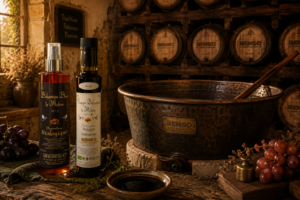
During its long aging process, the developing balsamic vinegar is transferred between several casks, each imparting its own signature character and patina. These casks are arranged in descending order of size; each size corresponds to a specific type of wood (oak, chestnut, cherry, ash, mulberry, and sometimes juniper) and, for the contents, a distinct stage of reduction driven by the liquid’s slow evaporation.
Le micro-climat de la région de Modène joue indubitablement The micro climate of the Modena region undoubtedly plays a significant role in this process. By setting up their *acetaia* (vinegar cellar) in seemingly unlikely locations (such as attics) producers actively encourage intense temperature fluctuations, which in turn contribute to the vinegar’s increasing complexity.